
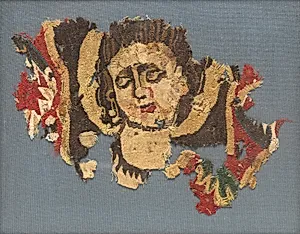
Fragment of a Woman
Unknown Artist
4th–5th century
Medium
Linen, polychrome wool
Dimensions
5 1/2 x 7 1/2 in. (14 × 19 cm)
Classification
Textiles-Woven
Culture
Early Byzantine
Department
Medieval Art
Museum
Metropolitan Museum of Art, New York, NY
Credit
Bequest of Nanette B. Kelekian, 2020
Accession Number
2021.37.7
Rights
Public Domain
Art Historical Context
This delicate *Fragment of a Woman*, to the 4th–5th century, offers a rare glimpse into Early Byzantine textile artistry. Crafted during the formative years of the Byzantine Empire—when Constantinople rose as a new cultural powerhouse—this woven linen piece adorned with vibrant polychrome wool likely formed part of a garment, curtain, or burial shroud. Such fragments, small yet evocative at just 5½ × 7½ inches, capture the elegance of everyday life in a world blending Roman traditions with emerging Christian influences. The medium highlights masterful weaving techniques: a fine linen ground embroidered or tapestry-woven with colorful wool yarns, achieving rich hues that have endured centuries. Textiles like this were prized in Byzantine society for their practicality and symbolism, often depicting human figures to convey status, piety, or beauty. Surviving examples are exceptionally scarce, as organic materials rarely withstand time, making this artifact a treasure for understanding fashion, trade routes (possibly from Egypt), and artistic patronage in the medieval world. Generously bequeathed to the Metropolitan Museum of Art in 2020 by Nanette B. Kelekian, it resides in the Medieval Art department, inviting visitors to marvel at the ingenuity of anonymous artisans whose work bridged antiquity and the Middle Ages.