
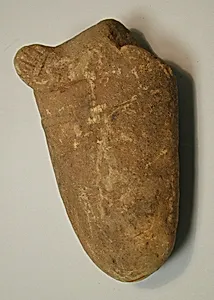
Fragment of a Zoomorphic Figure
Unknown Artist
ca. 1500 BCE– ?1600 CE
Medium
Stone, pigment
Dimensions
H. 5 1/4 x W. 9 5/8 in. (13.3 x 24.4 cm)
Classification
Stone-Sculpture
Culture
Southern Highlands
Department
Arts of Africa, Oceania, and the Americas
Museum
Metropolitan Museum of Art, New York, NY
Credit
Anonymous Gift, 1984
Accession Number
1984.123.2
Rights
Public Domain
Art Historical Context
This intriguing fragment of a zoomorphic figure, carved from stone and enhanced with pigment, hails from the Southern Highlands culture and dates roughly between 1500 BCE and 1600 CE. Measuring just 5¼ by 9⅝ inches (13.3 x 24.4 cm), it captures part of an animal-like form—possibly blending human and beastly traits, a motif common in ancient sculptures symbolizing spiritual power, ancestors, or totemic guardians. Housed in the Metropolitan Museum of Art's Department of Arts of Africa, Oceania, and the Americas, it was generously donated anonymously in 1984. The use of durable stone speaks to the artist's mastery of subtractive carving techniques, where material was meticulously shaped to evoke movement and life, while traces of pigment suggest vibrant coloration that once heightened its ritualistic presence. In Southern Highlands traditions, such figures often served ceremonial roles, bridging the earthly and supernatural worlds during a vast era spanning prehistoric to early contact periods. Though incomplete, this piece offers a window into enduring cultural practices, highlighting how ancient makers imbued everyday stone with profound meaning. A testament to lost narratives, it invites us to ponder the myths it once embodied.