
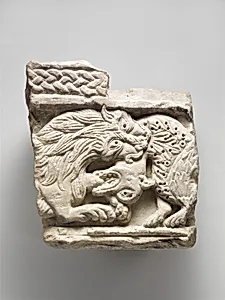
Fragment of an Animal Relief
Unknown Artist
ca. 1150
Medium
Marble (Lunense marble from Carrara)
Dimensions
Overall: 13 1/8 x 11 7/8 x 8 1/2 in. (33.3 x 30.2 x 21.6 cm) weight: 67lb. (30.4kg)
Classification
Sculpture-Stone
Culture
Italian
Department
Medieval Art
Museum
Metropolitan Museum of Art, New York, NY
Credit
Rogers Fund, 1909
Accession Number
09.152.8
Rights
Public Domain
Tags
Art Historical Context
This exquisite *Fragment of an Animal Relief carved around 1150 from fine Lunense marble quarried in Carrara, Italy, offers a glimpse into the vibrant world of Romanesque sculpture. Measuring just over a foot across and weighing a substantial 67 pounds, this piece likely once adorned a church portal, capital, or architectural frieze. The unknown Italian artist's skillful low-relief carving captures the dynamic form of an animal—possibly a lion or fantastical beast—common in medieval decoration, where such motifs symbolized strength, guardianship, or biblical narratives like Daniel in the lions' den. Carrara marble, prized for its purity and workability since Roman times, allowed sculptors to achieve intricate details and a luminous polish, bridging classical traditions with the robust, expressive style of the Romanesque period (c. 1000–1200). In 12th-century Italy, animal reliefs proliferated on cathedrals and monasteries, blending Christian symbolism with folkloric elements to educate and awe illiterate pilgrims. This fragment exemplifies the era's shift toward more naturalistic yet stylized forms, foreshadowing Gothic innovations. Acquired through the Rogers Fund in 1909 and housed in the Metropolitan Museum of Art's Medieval Art department, it invites us to ponder the grandeur of lost medieval ensembles, reminding visitors of the enduring allure of stone-carved stories from a faith-filled age.