
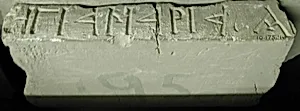
Fragment of an Inscribed Block
Unknown Artist
6th–7th century
Medium
Limestone; incised
Dimensions
H. 2 3/8 in. (6 cm) W. 12 5/8 in. (32.1 cm) D. 2 in. (5.1 cm)
Classification
Sculpture
Department
Islamic Art
Museum
Metropolitan Museum of Art, New York, NY
Credit
Rogers Fund, 1910
Accession Number
10.175.116
Rights
Public Domain
Art Historical Context
This modest yet evocative *Fragment of an Inscribed* offers a glimpse into the early of Islamic art, dating to the 6th–7th century Carved from limestone and incised with precise lines, this small sculpture—measuring just 2 3/8 inches high and 12 5/8 inches wide—survives as a broken piece of what was likely a larger architectural element, such as a lintel, frieze, or gravestone. The incising technique, where text or motifs are deeply cut into the stone surface, was a practical and durable method favored in regions like the Near East, ensuring legibility and longevity against weathering. In the Department of Islamic Art at the Metropolitan Museum of Art, acquired through the Rogers Fund in 1910, this fragment highlights the pivotal transition from late antiquity to the formative years of Islam. Inscriptions from this era often featured Arabic script, Qur'anic verses, or commemorative texts, serving religious, funerary, or dedicatory purposes. Such epigraphic works were central to early Islamic culture, blending Byzantine and Sasanian influences while pioneering the elegant Kufic script that defined the aesthetic of the new faith. Though incomplete, the piece underscores the artistry of anonymous stone carvers whose skill preserved history in stone. Visitors are invited to ponder the voices etched here, echoing across 1,400 years.