
Fragment of Archivolt
Unknown Artist
6th–7th century
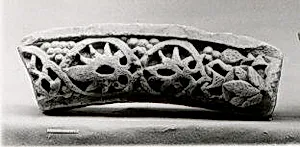
Medium
Limestone; carved in relief
Dimensions
H. 5 1/2 in. (14 cm) W. 19 11/16 in. (50 cm) D. 8 1/4 in. (21 cm)
Classification
Sculpture
Department
Islamic Art
Museum
Metropolitan Museum of Art, New York, NY
Credit
Rogers Fund, 1910
Accession Number
10.175.25
Rights
Public Domain
Art Historical Context
This exquisite *Fragment of Archivolt*, carved in limestone relief during the 6th–7th century, offers a glimpse into the dawn of Islamic art. Archivolts were ornate moldings framing arches in grand architectural settings, such as doorways or mihrabs in early mosques and palaces. Measuring just 5½ inches high but stretching nearly 20 inches wide, this modest survivor captures the refined stonework of a bygone era, acquired by The Metropolitan Museum of Art through the Rogers Fund in 1910. Crafted in low-relief technique, the sculpture exemplifies early Islamic sculptors' mastery of limestone—a durable, locally sourced material ideal for intricate architectural decoration across the nascent caliphates. Relief carving allowed for detailed patterns without venturing into fully three-dimensional figurative forms, aligning with emerging Islamic aesthetics that favored abstraction and geometry over representation. Though the artist remains unknown, this piece reflects the transitional fusion of late antique traditions with innovative Muslim motifs. Housed in the Met's Islamic Art department, it underscores the cultural flourishing from Syria to Mesopotamia during the formative Umayyad period. For visitors, it evokes the tactile elegance of ancient doorways, inviting reflection on how such fragments preserve the splendor of lost monuments.