
Fragment of Blazon
Unknown Artist
15th century
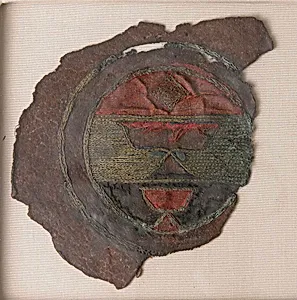
Medium
Leather, metal wire, wool, and cotton; embroidered
Dimensions
H. 4 1/4 in. (10.8 cm) W. 4 1/2 in. (11.4 cm)
Classification
Textiles-Embroidered
Department
Islamic Art
Museum
Metropolitan Museum of Art, New York, NY
Credit
Rogers Fund, 1972
Accession Number
1972.120.10
Rights
Public Domain
Tags
Art Historical Context
This delicate *Fragment of Blazon* from the 15th century a glimpse into the rich world of Islamic textiles, where embroidery served both decorative and symbolic purposes. Crafted from leather reinforced with metal wire, wool and cotton, this small piece—measuring just 4¼ by 4½ inches—was likely part of a larger emblematic banner, garment, or saddle decoration. The use of metal wire for stitching highlights advanced techniques that added durability and a shimmering effect, ideal for items carried in processions or battle. In the Islamic art tradition of the medieval period, such blazons functioned as identifiers, much like European heraldry, denoting tribal affiliations, military units, or noble lineages. Embroidered textiles were prized for their portability and prestige, often adorning tents, flags, or elite attire across the expansive realms from Persia to North Africa. Though the artist remains unknown, the fragment's survival speaks to the enduring craftsmanship of anonymous workshops. Today, housed in the Metropolitan Museum of Art's Islamic Art Department (acquired via the Rogers Fund in 1972), it invites us to ponder the vibrant, emblem-filled courts of the 15th century, where every stitch told a story of identity and power.