
Fragment of Border
Unknown Artist
14th century
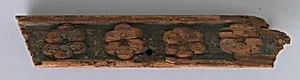
Medium
Wood; carved and painted
Dimensions
Ht. 1 1/8 in. (2.8 cm) W. 5 3/8 in. (13.7 cm) D. 1 3/16 in. (3 cm)
Classification
Wood
Department
Islamic Art
Museum
Metropolitan Museum of Art, New York, NY
Credit
Gift of Dr. Walter L. Hildburgh, 1951
Accession Number
51.45.1
Rights
Public Domain
Art Historical Context
This delicate *Fragment of Border*, crafted in the 14th century, offers a glimpse into the refined world of Islamic decorative arts. Carved and painted wood, just over 5 inches wide, this small surviving piece likely once adorned a larger architectural element such as a wooden screen panel, or mosque interior. Its modest—barely over an inch tall—highlight the exquisite precision required in medieval craftsmanship, where every curve and motif demanded masterful. In the Islamic world of the 14th, wood carving flourished as a key medium for non-figural decoration, emphasizing geometric patterns, arabesques, and floral motifs that symbolized infinity and divine order. The combination of carving for raised relief and painting for vibrant color enhanced its visual impact, often under low light in palaces or prayer halls. Though the artist remains unknown, such fragments exemplify the era's technical innovation and aesthetic restraint, adhering to aniconic traditions while dazzling the eye. Generously gifted to the Metropolitan Museum of Art in 1951 by Dr. Walter L. Hildburgh, this artifact invites us to imagine the opulent settings it once graced, preserving a whisper of medieval splendor for modern visitors.