
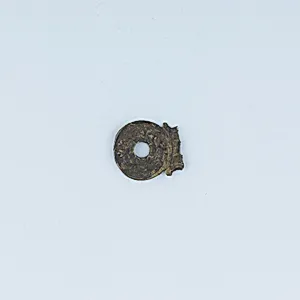
Fragment of Buckle
Unknown Artist
dated 1540
Medium
Brass
Dimensions
H. 5/8 in. (1.6 cm); W. 3/4 in. (1.9 cm); thickness 1/16 in. (0.2 cm); Wt. 0.03 oz. (1 g)
Classification
Miscellaneous-Buckles & Ornament
Culture
German
Department
Arms and Armor
Museum
Metropolitan Museum of Art, New York, NY
Credit
Gift of Bashford Dean, 1920
Accession Number
20.152.219
Rights
Public Domain
Art Historical Context
This delicate fragment of a brass buckle, dated 1540, offers a glimpse into everyday Renaissance craftsmanship from Germany. Measuring just 5/8 inch high and 3/4 inch wide, this tiny artifact—now housed in the Metropolitan Museum of Art's Arms and Armor Department—was likely part of a belt, strap, or armor fastening. Donated by Bashford Dean in 1920, it exemplifies the precision of 16th-century metalworking, where brass was prized for its durability, golden sheen, and workability. Crafted during the Holy Roman Empire's turbulent era of Reformation and warfare, such buckles blended functionality with subtle ornamentation. German artisans often cast brass pieces like this in molds, then chased or engraved details for both practical use and aesthetic appeal. Though incomplete, this fragment highlights how even utilitarian objects reflected the era's advancing techniques in small-scale metallurgy. As a classified "Miscellaneous-Buckle & Ornament," it underscores the cultural role of personal adornments in signaling status among soldiers, nobles, or burghers. Imagine it securing a leather baldric or doublet— a quiet testament to the ingenuity of anonymous makers whose work armed and adorned a changing Europe.