
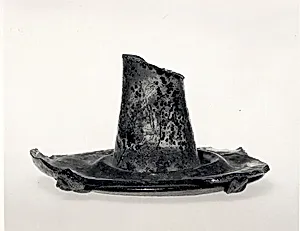
Fragment of Inkwell
Unknown Artist
probably 10th century
Medium
Glass, greenish; applied decoration
Dimensions
L. (of cylinder): 1 1/4 in. (3.2 cm) Max. Diam. 2 13/16 in. (7.2 cm)
Classification
Glass
Department
Islamic Art
Museum
Metropolitan Museum of Art, New York, NY
Credit
Rogers Fund, 1948
Accession Number
48.101.275
Rights
Public Domain
Art Historical Context
This delicate fragment of an inkwell likely from the 10th, offers a glimpse into the refined world of Islamic artistry during the Abbasid era. Crafted from greenish glass—a hue achieved through natural impurities in the silica—this small cylindrical piece (just 1¼ inches long and nearly 3 inches in diameter once held ink for scribes and scholars. Inkwells like this were everyday tools in a culture where calligraphy was both an art form and a sacred practice, essential for copying the Quran and advancing knowledge in science, poetry, and philosophy. The applied decoration technique highlights the ingenuity of Islamic glassmakers, who heated trails of molten glass onto the body to create textured motifs, adding both aesthetic appeal and functionality to prevent slipping. Such methods flourished in regions like Syria and Egypt, where glass production reached new heights of sophistication. Though only a fragment survives, it evokes the vibrancy of medieval Islamic workshops, where humble objects embodied elegance and utility. Acquired through the Rogers Fund in 1948, this piece from The Metropolitan Museum of Art's Islamic Art collection reminds us how everyday artifacts preserve stories of innovation and cultural devotion. Visitors can appreciate its subtle glow under gallery lights, a testament to enduring craftsmanship.