
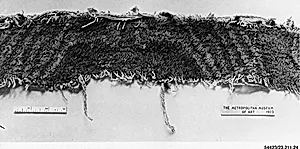
Fragment of Rug
Unknown Artist
18th century
Medium
Foundation: cotton, warp and weft; wool knotting
Dimensions
39 1/2 x 3 1/2 in. (100.33 x 8.89 cm)
Classification
Textiles-Rugs
Culture & Period
China · Qing dynasty (1644–1911)
Department
Asian Art
Museum
Metropolitan Museum of Art, New York, NY
Credit
Rogers Fund, 1923
Accession Number
23.211.24
Rights
Public Domain
Art Historical Context
This delicate fragment of a, hailing from 18th-century China during Qing dynasty (16441911), offers a glimpse into the refined world of imperial textile artistry. Measuring a slender 39½ x 3½ inches, it as a narrow strip, likely part of a larger floor covering or decorative hanging prized in elite households. Acquired through the Rogers Fund in 1923, it now graces the Metropolitan Museum of Art Asian Art collection, showcasing the sophistication of Qing-era craftsmanship. Crafted with a cotton foundation of warp and weft threads, the rug features intricate wool knotting that creates a plush pile surface—a technique blending durability with luxurious texture. This method, common in Chinese rug-making, allowed weavers to produce vibrant, resilient pieces capable of withstanding heavy use while displaying bold patterns and colors, though the fragment's design details have faded over time. In the Qing dynasty, textiles like this were symbols of status and cultural exchange, influenced by trade along the Silk Road. Rugs elevated everyday floors into canvases of artistry, reflecting the era's prosperity and technical mastery. Visitors, imagine the soft wool underfoot in a grand pavilion—this fragment invites us to appreciate the enduring legacy of anonymous artisans.