
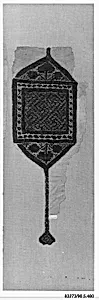
Fragment of Shoulder Band
Unknown Artist
3rd–4th century
Medium
Wool, linen; plain weave, tapestry weave
Dimensions
Max. H. 2 3/8 in. (6 cm) Max. W. 3 15/16 in. (10 cm)
Classification
Textiles
Department
Islamic Art
Museum
Metropolitan Museum of Art, New York, NY
Credit
Gift of George F. Baker, 1890
Accession Number
90.5.479
Rights
Public Domain
Art Historical Context
This delicate *Fragment of Shoulder Band* from the 3rd–4th century offers a glimpse into the vibrant textile traditions of the Late Antique world, likely from Egypt or the Near East. Crafted from wool and linen using plain weave for the ground and tapestry weave for colorful motifs, this small piece (just 2 3/8 by 3 15/16 inches) once adorned the shoulder of a garment, such as a tunic. Tapestry weave, a labor-intensive technique where discontinuous colored wefts create intricate patterns without floating threads, was prized for its durability and decorative appeal on clothing worn daily or for special occasions. In the Metropolitan Museum of Art's Department of Islamic Art, this fragment highlights the continuity of ancient weaving skills that bridged pre-Islamic and early Islamic eras. Such bands often featured geometric or floral designs symbolizing protection or status, reflecting the cultural fusion of Roman, Byzantine, and local influences. Though the artist remains unknown, the precision of the work speaks to skilled workshops producing textiles for both elite and everyday use. A generous gift from George F. Baker in 1890, this artifact invites us to appreciate the artistry in fragments—tiny survivors that preserve the textures of ancient lives.