
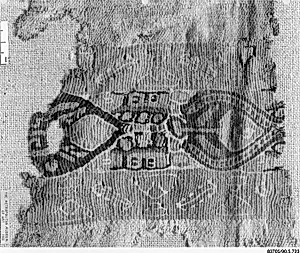
Fragment of Shoulder Band
Unknown Artist
5th–6th century
Medium
Wool, linen; plain weave, tapestry weave
Dimensions
Max. H. 9 1/16 in. (23 cm) Max. W. 7 1/16 in. (18 cm)
Classification
Textiles
Department
Islamic Art
Museum
Metropolitan Museum of Art, New York, NY
Credit
Gift of George F. Baker, 1890
Accession Number
90.5.723
Rights
Public Domain
Art Historical Context
This delicate fragment of a shoulder band, dating to the 5th–6th century, offers a glimpse into the textile artistry of the early Islamic world, likely from regions like Egypt or the Near East where late antique traditions flourished. As part of a garment—possibly a tunic—the narrow band would have adorned the shoulder seam, showcasing the wearer's status through intricate decoration. Housed in the Metropolitan Museum of Art's Department of Islamic Art, this piece was generously gifted by George F. Baker in 1890, preserving a tangible link to daily life in a transformative era bridging Byzantine, Sasanian, and emerging Islamic cultures. Crafted from wool and linen using plain weave for the foundation and tapestry weave for vibrant motifs, the fragment highlights sophisticated weaving techniques. Tapestry weave, where colored weft threads are woven perpendicular to the warp to create pictorial designs, allowed for bold patterns without additional embroidery. Though worn and fragmentary (measuring just 9 1/16 x 7 1/16 inches), it exemplifies the durability and aesthetic refinement of ancient textiles, often featuring geometric or floral motifs that influenced later Islamic ornamental traditions. For visitors, this unassuming survivor underscores how textiles were vital cultural artifacts—exported along trade routes, buried with the dead, and revered for their craftsmanship—revealing the artistry of unknown makers whose work shaped centuries of design.