
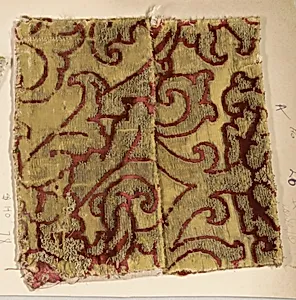
Fragment of velvet
Unknown Artist
early 16th century
Medium
Silk, metal thread
Dimensions
Overall: 7 1/2 x 7 3/4 in. (19.1 x 19.7 cm)
Classification
Textiles-Velvets
Culture
Italian or Spanish
Department
European Sculpture and Decorative Arts
Museum
Metropolitan Museum of Art, New York, NY
Credit
Gift of Nanette B. Kelekian, in honor of Olga Raggio, 2002
Accession Number
2002.494.125
Rights
Public Domain
Art Historical Context
This exquisite fragment of velvet, dating to the early 16th century, hails from either Italy or Spain—two powerhouses of Renaissance textile artistry. Measuring a modest 7½ x 7¾ inches (19.1 x 19.7 cm), it survives as a tantalizing glimpse into the opulent world of European decorative arts. During this era, velvet was a symbol of wealth and status, adorning ecclesiastical vestments, noble garments, and lavish furnishings in courts across Europe. Crafted from luxurious silk woven with shimmering metal threads, the piece showcases advanced weaving techniques like voided velvet, where intricate patterns emerge from cut-pile loops against a satin ground. The metallic accents—likely gold or silver—would have caught the light dramatically, evoking divine radiance or royal splendor. Such velvets were labor-intensive marvels, produced in specialized workshops like those in Venice or Genoa for Italy, or Toledo for Spain, blending Islamic influences with Christian iconography. Today, this fragile treasure resides in The Metropolitan Museum of Art's Department of European Sculpture and Decorative Arts, a gift from Nanette B. Kelekian in honor of curator Olga Raggio (2002). It invites us to marvel at the anonymous artisans whose skill turned thread into timeless luxury.