
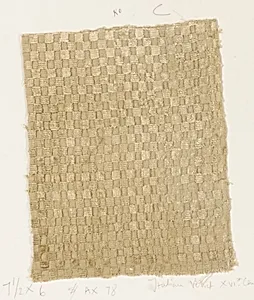
Fragment of velvet
Unknown Artist
16th century
Medium
Silk
Dimensions
Overall: 7 3/4 x 6 1/4 in. (19.7 x 15.9 cm)
Classification
Textiles-Velvets
Culture
Italian
Department
European Sculpture and Decorative Arts
Museum
Metropolitan Museum of Art, New York, NY
Credit
Gift of Nanette B. Kelekian, in honor of Olga Raggio, 2002
Accession Number
2002.494.532
Rights
Public Domain
Art Historical Context
This exquisite fragment of silk velvet, hailing from 16th-century Italy, a tantalizing glimpse into the Renaissance era's opulent textile traditions. Measuring just 7 3/4 x 6 1/4 inches (19.7 x 15.9 cm), this survivor showcases the masterful weaving techniques of Italian artisans, who were renowned across Europe for producing luxurious velvets. Crafted from fine silk, the fabric's characteristic pile—created by cutting loops during weaving—produces a rich, shimmering texture that catches the light, evoking the grandeur of the period. In the 16th century, Italian velvets like this one were symbols of wealth and status, adorning ecclesiastical vestments, noble garments, and palatial furnishings. Centers like Venice and Genoa dominated the trade, exporting these treasures to courts far and wide. Though the exact design and original use remain mysteries due to its fragmentary state, it exemplifies the technical sophistication and aesthetic refinement of European decorative arts, highlighting silk's role as a prized import from the East, transformed into high fashion. Today, housed in the Metropolitan Museum of Art's Department of European Sculpture and Decorative Arts (gift of Nanette B. Kelekian in honor of Olga Raggio, 2002), this piece invites us to appreciate the fragility of historical textiles—often the unsung heroes of art history that draped the lives of the elite.