
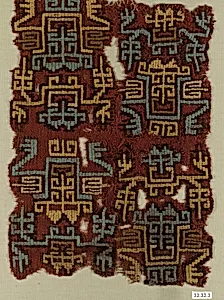
Fragment with Figures
Unknown Artist
7th century
Medium
Camelid hair
Dimensions
Overall: 8 x 11 in. (20.32 x 27.94 cm) Other: 8 in. (20.32 cm)
Classification
Textiles-Woven
Culture
Nasca
Department
Arts of Africa, Oceania, and the Americas
Museum
Metropolitan Museum of Art, New York, NY
Credit
Gift of George D. Pratt, 1932
Accession Number
32.32.3
Rights
Public Domain
Art Historical Context
This exquisite *Fragment with Figures*, woven in the 7th century by an unknown Nasca artist, a glimpse into the sophisticated textile traditions of ancient Peru's Nasca culture (ca. 100 BCE–800 CE). Hailing from the arid southern coast, the Nasca people were master weavers who transformed camelid hair—fine wool from alpacas and llamas—into vibrant, durable fabrics. Measuring just 8 x 11 inches, this woven fragment likely survived from a larger garment or ritual cloth, preserved through Peru's dry climate and ancient burial practices. Nasca textiles like this one showcase advanced weaving techniques, such as discontinuous warps and wefts, which allowed for intricate, pictorial designs akin to paintings on cloth. The "figures" probably depict mythological beings, warriors, or deities, reflecting the Nasca worldview filled with supernatural motifs seen in their famous ceramics and Nazca Lines geoglyphs. These textiles held profound cultural importance, serving as elite status symbols, offerings to the dead, and embodiments of cosmological beliefs. Today, this fragile treasure resides in the Metropolitan Museum of Art's Department of the Arts of Africa, Oceania, and the Americas, gifted in 1932. It invites us to marvel at the Nasca's artistry, where every thread wove stories of life, death, and the divine.