
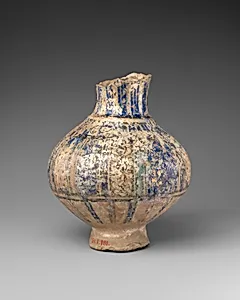
Fragmentary Ewer
Unknown Artist
14th century
Medium
Earthenware; glazed
Dimensions
H. 8 1/2 in. (21.6 cm) Max Diam. 6 1/2 in. (16.5 cm)
Classification
Ceramics
Department
Islamic Art
Museum
Metropolitan Museum of Art, New York, NY
Credit
Edward C. Moore Collection, Bequest of Edward C. Moore, 1891
Accession Number
91.1.181
Rights
Public Domain
Art Historical Context
This delicate **Fragmentary Ewer**, in the 14th century from glazed earthenware, offers a glimpse into the refined world of Islamic ceramics. Standing at just 8 1/2 inches tall with a maximum diameter of 1/2 inches, this vessel—likely used for pouring water or rosewater in daily rituals or hospitality—was part of a vibrant tradition of pottery-making across the Islamic world, from Persia to the Mediterranean. Glazed earthenware was a hallmark of 14th-century Islamic artistry, where potters mastered low-fired clay coated with durable, often colorful glazes to mimic pricier Chinese porcelain. Though fragmentary today, such ewers showcased technical prowess in shaping bulbous bodies and elegant spouts, sometimes adorned with intricate motifs like arabesques or calligraphy—symbols of cultural and spiritual depth. These objects bridged utility and beauty, essential for ablutions in mosques or elegant dining. Housed in the Metropolitan Museum of Art's Islamic Art Department, this piece entered the collection through the bequest of Edward C. Moore in 1891. It reminds us how everyday ceramics preserved artistic innovation amid medieval trade and cultural exchange, inviting us to appreciate the enduring legacy of anonymous makers.