
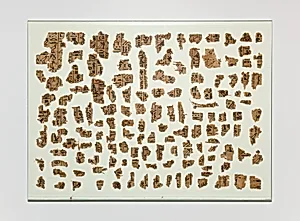
Fragments from a Book of the Dead
Unknown Artist
ca. 1390–1353 B.C.?
Medium
Papyrus, ink
Dimensions
mounted in 4 frames, each 28.2 x 38 cm (11 1/8 x 14 15/16 in.)
Classification
Papyrus, funerary, Book of the Dead
Period
New Kingdom
Department
Egyptian Art
Museum
Metropolitan Museum of Art, New York, NY
Credit
Rogers Fund, 1928
Accession Number
28.3.299a–d-related
Rights
Public Domain
Tags
Art Historical Context
These delicate fragments from a *Book of the Dead*, dating to around 1390–1353 B.C. during Egypt's New Kingdom (Dynasty 18, possibly), offer a mesmerizing glimpse into ancient funerary practices. Crafted by an unknown scribe on papyrus with black and colored inks, the pieces are mounted in four, each measuring about 28 x 38 cm. Now housed in the Metropolitan Museum of Art's Egyptian Art (acquired via the Rogers Fund in 8), they bear intricate hieroglyphs—Egypt's sacred pictorial script—that once formed part of a personalized guide for the afterlife. The *Book of the Dead* was no mere book but a vital "spellbook" for the deceased, compiling over 200 magical formulas, hymns, and vignettes to navigate the perilous underworld, overcome judgment by Osiris, and achieve eternal life in the Field of Reeds. Produced during the prosperous New Kingdom, when pyramid-building had given way to elaborate tombs like those in the Valley of the Kings, these texts democratized immortality; they weren't just for pharaohs but for elites who could afford them. Artistically, the fragments showcase masterful hieroglyphic calligraphy—linear and symbolic—rendered with precision on fragile papyrus made from Nile reeds. This medium's perishability makes surviving examples rare treasures, revealing how Egyptians blended art, religion, and literacy in a vibrant, colorful tradition that influenced millennia of spiritual expression.