
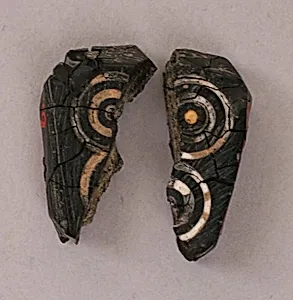
Fragments of a Bead
Unknown Artist
8th–13th century
Medium
Jet; cut, drilled, and inlaid
Dimensions
48.101.250a: Ht. 1/2 in. (1.3 cm) W. 3/8 in. (0.9 cm) D. 3/16 in. (0.4 cm) 48.101.250b: H. 9/16 in. (1.5 cm) W. 1/4 in. (0.7 cm) D. 3/16 in. (0.4 cm)
Classification
Jewelry
Department
Islamic Art
Museum
Metropolitan Museum of Art, New York, NY
Credit
Rogers Fund, 1948
Accession Number
48.101.250
Rights
Public Domain
Art Historical Context
These delicate fragments of a bead, crafted from jet between the 8th and 13th, offer a glimpse into the exquisite jewelry traditions of the Islamic world., a dense black lignite prized for its glossy polish and lightweight durability, was a favored material for personal adornments like necklaces, amulets, and prayer beads. Acquired through the Rogers Fund in 1948, these pieces (cataloged as 48.101.250a and b) now reside in The Metropolitan Museum of Art's Department of Islamic Art, showcasing the museum's commitment to preserving such intimate artifacts. The tiny dimensions—measuring just a half-inch high for one fragment and slightly larger for the other—highlight the remarkable precision of ancient techniques. Artisans meticulously cut the jet to shape, drilled holes for stringing, and added inlays, likely of contrasting materials like gold or shell, to create visual depth and sparkle. This labor-intensive process reflects the high value placed on jewelry in medieval Islamic societies, where such beads served both decorative and possibly protective roles, warding off evil or symbolizing status. Though incomplete, these fragments embody the artistry of a golden age of Islamic craftsmanship, bridging early Abbasid and later medieval periods. They remind us how everyday objects carried profound cultural weight, blending functionality with beauty in the hands of unnamed masters.