
François de la Mothe
1661
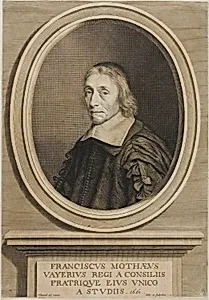
Medium
Engraving on cream laid paper
Dimensions
Trimmed to edge of image: 27.1 × 18.8 cm (10 11/16 × 7 7/16 in.)
Classification
engraving
Department
Prints and Drawings
Museum
Art Institute of Chicago
Accession Number
71856
Rights
Public Domain
Art Historical Context
Created in 1661 by the celebrated French engraver Robert Nanteuil, this portrait depicts François de la Mothe, a figure of note in seventeenth-century France. Nanteuil was renowned for his refined portrait engravings, which captured the likenesses of statesmen, scholars, and members of the royal court during the early years of Louis XIV’s reign. Such works served both as personal memorials and as vehicles for circulating images of influential individuals across Europe. Executed as an engraving on cream laid paper, the print demonstrates the meticulous technique for which Nanteuil was admired. Using fine lines and subtle tonal gradations, he translated the textures of fabric, hair, and facial features into a convincing likeness. At roughly 27 by 19 centimeters, the trimmed sheet would have been suitable for inclusion in albums or frames, making the image accessible to a wider audience than a unique painting could reach. Today housed in the Art Institute of Chicago’s Department of Prints and Drawings, this engraving offers a glimpse into the vibrant print culture of Baroque France. It highlights how artists like Nanteuil combined technical precision with artistic sensitivity to preserve the presence of their contemporaries for future generations.
About the Artist
Robert Nanteuil · 1623–1678
Robert Nanteuil (1623-1678) was a French portrait engraver, draughtsman, and pastellist who became the preeminent portraitist to the court of Louis XIV. His technical mastery and royal patronage fundamentally transformed the status of engraving in France, elevating it from a mechanical craft to a recognized fine art. Nanteuil stands as the outstanding French portrait engraver of the seventeenth c...