
François Marie Arouet de Voltaire
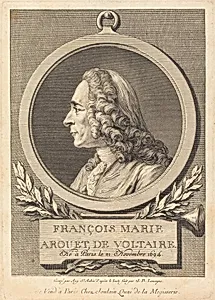
Medium
etching and engraving on laid paper
Dimensions
plate: 19.6 x 13.7 cm (7 11/16 x 5 3/8 in.) sheet: 20.2 x 14.3 cm (7 15/16 x 5 5/8 in.)
Classification
Department
CG-E
Museum
National Gallery of Art, Washington, D.C.
Credit
Gift of John O'Brien
Accession Number
1987.70.17
Rights
Public Domain
Art Historical Context
This striking print captures the likeness of François-Marie Arouet, known as Voltaire, one the Enlightenment’s most influential writers and. Created before 177 by Augustin de Saint-Aubin after a design by sculptor Jean-Baptiste Lemoyne, the work presents Voltaire in a dignified bust-length portrait that emphasizes his intellect and expressive features. As a reproductive print, it allowed Voltaire’s image to circulate widely among admirers across Europe at a time when his ideas on reason, tolerance, and social reform were reshaping intellectual life. Saint-Aubin employed etching and engraving techniques on laid paper, combining fine lines with delicate tonal effects to translate Lemoyne’s sculptural model into a two-dimensional format. Such prints were essential in the eighteenth century for disseminating portraits of celebrated figures, transforming private likenesses into public icons. The modest size—roughly the dimensions of a small book page—made the image suitable for inclusion in personal collections or publications. Today, this impression in the National Gallery of Art’s collection reminds visitors how visual culture helped spread Enlightenment ideals. Gifted by John O’Brien, the print preserves both Voltaire’s enduring presence and the collaborative artistry that brought his image to a broader audience.