
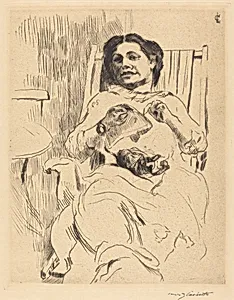
Frau mit Handarbeit (Woman with Needlework)
1912
Medium
drypoint in black on wove paper
Dimensions
plate: 24.8 x 19.6 cm (9 3/4 x 7 11/16 in.) sheet: 37.9 x 24.5 cm (14 15/16 x 9 5/8 in.)
Classification
Department
CG-W
Museum
National Gallery of Art, Washington, D.C.
Credit
Gift of the Marcy Family in memory of Sigbert H. Marcy
Accession Number
1991.210.24
Rights
Public Domain
Art Historical Context
**Frau mit Handarbeit (Woman with Needlework)**, created by German artist Lovis Corinth in 1912, captures an intimate domestic moment through the elegant medium of drypoint etching on wove paper. Measuring 24.8 x 19.6 cm on the plate, this black-ink print depicts a woman absorbed in needlework, her pose conveying quiet concentration and everyday grace. Corinth, a leading figure in early 20th-century German art, transitioned from Impressionist influences to a bolder Expressionist style, marked by vigorous lines and emotional depth. Drypoint, Corinth's chosen technique, involves scratching directly into a metal plate, producing rich, velvety burrs that lend the image a tactile immediacy and spontaneity rare in prints. This work, made shortly after Corinth's debilitating stroke in 1911, reflects his resilient late style—loose, dynamic, and infused with personal intensity. It exemplifies his mastery of printmaking, bridging painting's expressiveness with the precision of intaglio. Housed in the National Gallery of Art as a gift from the Marcy Family, this piece invites visitors to appreciate Corinth's ability to elevate ordinary life into profound artistry, highlighting the cultural role of women in early modern households amid Europe's artistic upheavals. (198 words)
About the Artist
Lovis Corinth · 1858–1925
Lovis Corinth, born Franz Heinrich Louis on July 21, 1858, in Tapiau, East Prussia (now Gvardeysk, Russia), to a tanner father, displayed prodigious drawing talent from childhood. He began formal training at the Königsberg Academy in 1876, then moved to the Academy of Fine Arts in Munich from 1880 to 1884, studying under Ludwig von Löfftz and briefly Franz von Defregger, where he absorbed a Realis...