
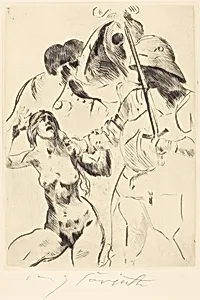
Frauenraub III (Abduction III)
1914
Medium
drypoint in black on laid paper
Dimensions
plate: 27 x 19.6 cm (10 5/8 x 7 11/16 in.) sheet: 45.7 x 34.1 cm (18 x 13 7/16 in.)
Classification
Department
CG-W
Museum
National Gallery of Art, Washington, D.C.
Credit
Gift of the Marcy Family in memory of Sigbert H. Marcy
Accession Number
1991.210.46
Rights
Public Domain
Art Historical Context
Lovis Corinth's *Frauenraub III (Abduction III)*, in 1914, is a striking drypoint print that captures the artist's mastery of graphic expression during a pivotal moment in European history. As a leading figure in German modernism, Corinth had evolved from Impressionist influences to a bold Expressionist style by his later years, marked by intense emotion and dynamic forms. This work, the third in a series evoking mythological themes of abduction—likely drawing from classical narratives like the Rape of Sabine Women—reflects his fascination with dramatic, human-centered subjects amid the looming shadow of World War I. Executed in drypoint on laid paper, the technique involves scratching directly into a metal plate with a sharp tool, raising a soft burr that yields rich, velvety black lines with a painterly texture. This intimate medium, with its plate size of 27 x 19.6 cm, allowed Corinth to mimic the spontaneity of drawing while achieving subtle tonal depths impossible in other prints. The larger sheet (45.7 x 34.1 cm) enhances its presence as a standalone artwork. Housed in the National Gallery of Art's print collection (CG-W) as a gift from the Marcy Family in memory of Sigbert H. Marcy, *Frauenraub III* exemplifies Corinth's innovative printmaking, bridging his oil paintings' vigor with the precision of graphic art. Visitors will appreciate its raw energy, a testament to an artist's enduring creativity on the brink of global upheaval.
About the Artist
Lovis Corinth · 1858–1925
Lovis Corinth, born Franz Heinrich Louis on July 21, 1858, in Tapiau, East Prussia (now Gvardeysk, Russia), to a tanner father, displayed prodigious drawing talent from childhood. He began formal training at the Königsberg Academy in 1876, then moved to the Academy of Fine Arts in Munich from 1880 to 1884, studying under Ludwig von Löfftz and briefly Franz von Defregger, where he absorbed a Realis...