
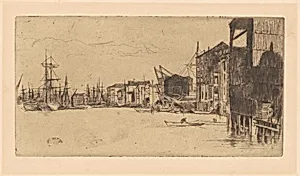
Free Trade Wharf
Medium
etching and drypoint in black on laid paper
Dimensions
plate: 9.68 × 18.73 cm (3 13/16 × 7 3/8 in.) sheet: 17.78 × 26.35 cm (7 × 10 3/8 in.)
Classification
Department
CG-W
Museum
National Gallery of Art, Washington, D.C.
Credit
Corcoran Collection (Bequest of Julius Garfinckel)
Accession Number
2015.19.411
Rights
Public Domain
Art Historical Context
James McNeill Whistler’s *Free Trade Wharf* (1877) exemplifies the artist’s mastery of printmaking during his London years. An American-born painter and etcher associated with the Aesthetic Movement, Whistler approached etching as an independent art form rather than mere reproduction. Here he combines etching’s crisp linear precision with drypoint’s velvety burr to evoke the quiet activity along a riverside wharf, demonstrating his interest in tonal harmony and atmospheric suggestion over literal description. The modest plate size—roughly 4 by 7 inches—encourages intimate viewing, inviting visitors to appreciate the subtle gradations of black ink on laid paper. Such works contributed to the nineteenth-century etching revival, elevating the medium’s status in both Britain and America. Acquired through the Corcoran Collection’s bequest of Julius Garfinckel, this impression now resides in the National Gallery of Art, where it preserves Whistler’s refined vision of modern urban life.
About the Artist
James McNeill Whistler · 1834–1903
James Abbott McNeill Whistler (1834-1903) was an American-born painter and printmaker who became a leading figure in the Aesthetic Movement and pioneer of Tonalism and Japonisme. He revolutionized art by championing "art for art's sake" and treating paintings as visual equivalents of musical compositions, titling works as "arrangements," "harmonies," and "nocturnes" to emphasize formal qualities o...