
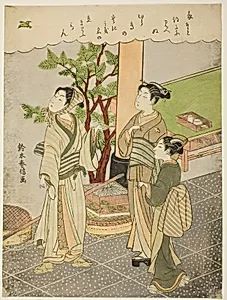
Freeing a captured bird
c. 1769/70
Medium
Color woodblock print; chuban
Dimensions
28.5 × 21.1 cm (11 1/8 × 8 1/2 in.)
Classification
woodblock print
Department
Arts of Asia
Museum
Art Institute of Chicago
Accession Number
21043
Rights
Public Domain
Art Historical Context
Suzuki Harunobu's *Freeing a Captured Bird* (c. 1769/70) is a delicate color woodblock print from Japan's Edo period, exemplifying the ukiyo-e tradition of "pictures of the floating world." Harunobu (1725–1770), a pioneer in full-color nishiki-e prints, revolutionized the medium around 1765 by layering vibrant hues through multiple carved woodblocks. This chuban-format work (28.5 × 21.1 cm), smaller and more intimate than larger ōban prints, was affordable for urban merchants and samurai, reflecting the booming print culture of 18th-century Tokyo. The scene likely depicts a graceful woman gently releasing a caged bird, a motif symbolizing freedom, transience, and compassion—common in Japanese art influenced by Buddhist ideas of impermanence. Harunobu's mastery shines in his subtle gradations (bokashi technique), soft textures, and luminous colors, evoking quiet poetry. Printed late in his short career, it captures the elegance of bijin-ga (pictures of beautiful women), blending everyday grace with poetic symbolism. Housed in the Art Institute of Chicago's Arts of Asia department, this print offers a window into Harunobu's legacy: bridging single-color traditions to the multicolored extravagance that inspired later masters like Hokusai and Hiroshige. A timeless meditation on liberty, it invites visitors to ponder the fleeting beauty of life.
About the Artist
Suzuki Harunobu · 1725–1770
Suzuki Harunobu (c. 1725-1770) was a Japanese ukiyo-e artist who revolutionized woodblock printing by developing nishiki-e—full-color prints using multiple woodblocks—in 1765. Before Harunobu, Japanese prints were limited to two or three colors; his innovation unleashed the entire artist's palette, transforming ukiyo-e into the vibrant art form that would later captivate Western artists from Manet...