
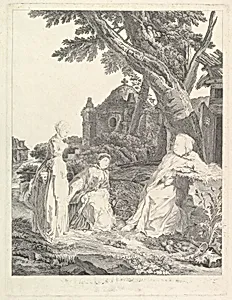
Frère Luce
Medium
Etching
Dimensions
sheet: 20 3/8 x 14 15/16 in. (51.8 x 38 cm) image: 15 5/8 x 12 3/8 in. (39.7 x 31.4 cm)
Classification
Prints
Department
Drawings and Prints
Museum
Metropolitan Museum of Art, New York, NY
Credit
The Elisha Whittelsey Collection, The Elisha Whittelsey Fund, 1959
Accession Number
59.608.67
Rights
Public Domain
Tags
Art Historical Context
Gabriel de Saint-Aubin’s *Frère Luce* (1767) is a captivating etching that captures the charm of 18th-century life. Saint-Aubin, a prolific artist and master engraver (1724–1780), was renowned for his intricate vignettes of urban scenes, architecture, and activities, often infused with the playful elegance of the Rococo style transitioning toward Neoclassicism. This large-scale print—measuring nearly 20 by 15 inches on the sheet—showcases his skill in rendering fine details through etching, a technique using acid to bite into a metal plate, allowing for delicate lines and tonal depth that brought immediacy to his observations of Paris. The composition features buildings, women, and trees, evoking a lively outdoor tableau that blends urban and natural elements. Likely depicting a moment from everyday life—perhaps a park or garden scene with figures like the titular "Frère Luce" (Brother Luce)—it reflects the era’s fascination with leisure and social vignettes amid the opulent pre-Revolutionary world. Etchings like this were popular for their affordability, disseminating artistic views to a wide audience beyond elite collectors. Housed in the Metropolitan Museum of Art’s Drawings and Prints department as part of The Elisha Whittelsey Collection, *Frère Luce* offers a window into Saint-Aubin’s prolific output of over 1,000 prints. It highlights how printmaking democratized art, preserving fleeting glimpses of 1760s France for modern visitors to savor.
About the Artist
Gabriel de Saint-Aubin · 1724–1780
Gabriel de Saint-Aubin (1724–1780) was one of the most vivid and irrepressible graphic artists of eighteenth-century France, a tireless draughtsman whose sketchbooks and prints constitute an extraordinary visual chronicle of Parisian life during the Ancien Régime. Born into a family with strong connections to the decorative arts — his father was an embroiderer to the king — Saint-Aubin received fo...