
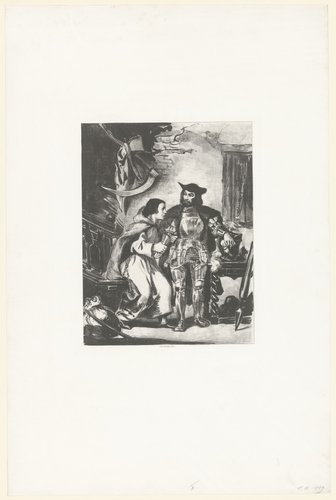
Frère Martin serrant la main de fer de Goetz
in of na 1836 - in of voor 1843
Medium
chalk lithograph
Dimensions
360; 545
Rights
Public Domain
About this artwork
Purchased with the support of the F.G. Waller-Fonds
Art Historical Context
**Frère Martin serrant la de fer de Goetz is a striking chalk lithograph by Eugène Delacroix, the leading figure of French Romanticism, created sometime between 1836 and1843. Measuring 545 × 360 mm, this captures a dramatic moment from Johann Wolfgang von Goethe's play *Götz von Berlichingen*, where the Frère Martin clasps the iron prosthetic hand of the titular knight, Götz—a symbol of defiance and resilience drawn from 16th-century German history. Delacroix, renowned for his passionate depictions of literature and emotion, brings the scene to life with expressive intensity, embodying Romanticism's emphasis on individualism, turmoil, and the sublime. Delacroix's mastery of lithography shines here. Using chalk crayon on lithographic stone, he achieved rich tonal variations and fluid lines that mimic the spontaneity of his oil sketches, making this print a bridge between painting and graphic art. Lithography, popularized in the early 19th century, allowed artists like Delacroix to disseminate their visions widely, influencing book illustrations and popular culture. Acquired with support from the F.G. Waller-Fonds, this piece highlights Delacroix's innovative printmaking during his mature career, offering visitors a window into Romanticism's fusion of history, literature, and bold technique.
About the Artist
Eugène Delacroix · 1798–1863
Eugène Delacroix (1798–1863) stands as the defining figure of French Romanticism and a pivotal bridge to modernism. Born in Charenton-Saint-Maurice near Paris, he came from distinguished lineage—his mother descended from the prestigious Oeben-Riesener furniture dynasty, while persistent speculation suggested the statesman Talleyrand may have been his biological father, a theory supported by physic...