
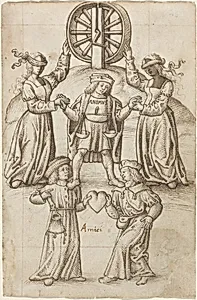
"Friendship Is Equality; A Friend Is Another Self" [fol. 10 recto]
c. 1512/1515
Medium
pen and brown ink with brown wash on laid paper
Dimensions
overall: 16.3 x 10.7 cm (6 7/16 x 4 3/16 in.)
Classification
Drawing
Department
CG-E
Museum
National Gallery of Art, Washington, D.C.
Credit
Woodner Collection, Gift of Andrea Woodner
Accession Number
2006.11.42
Rights
Public Domain
Art Historical Context
In this drawing, two women in flowing gowns stand on either side of a large wheel, their hands raised to support it above a central figure labeled “ANIMUS.” This figure, dressed in a short tunic, holds a pair of balance scales while two young men at the bottom of the sheet grasp a heart between them, one pointing upward. The entire scene is rendered in fine pen lines and subtle brown washes on laid paper, creating a balanced, symmetrical composition that draws the eye from the wheel at the top down to the heart below. Titled “Friendship Is Equality; A Friend Is Another Self,” the sheet was made in France around 1512–1515. It belongs to a small group of early sixteenth-century drawings that translate classical ideas about friendship into visual form. The artist uses clear symbols—the wheel of fortune, the scales of justice, and the shared heart—to suggest that true equality and mutual affection stand at the heart of lasting friendship. Now in the National Gallery of Art as part of the Woodner Collection, the drawing invites viewers to consider how Renaissance artists turned abstract moral concepts into memorable images. Its modest size and precise technique show how such ideas could be studied and shared in the intimate setting of a book or album.