
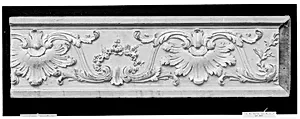
Frieze fragment
Unknown Artist
late 17th–early 18th century
Medium
Wood, painted gray
Dimensions
9 1/2 × 32 3/4 in. (24.1 × 83.2 cm)
Classification
Woodwork
Culture
French
Department
European Sculpture and Decorative Arts
Museum
Metropolitan Museum of Art, New York, NY
Credit
Gift of J. Pierpont Morgan, 1906
Accession Number
07.225.231
Rights
Public Domain
Art Historical Context
This delicate frieze fragment, crafted in France during the late 17 to early 18th century, offers a glimpse into the grandeur of the Louis XIV era and the transitioning Regency style. Measuring just 9½ × 32¾ inches, this slender band of painted gray wood once adorned the walls of a lavish interior, likely a château or hôtel particulier, where such elements framed ceilings, doorways, or panels to create rhythmic architectural harmony. As a prime example of French woodwork in the decorative arts tradition, the piece showcases the era's mastery of boiseries—intricately carved and painted wooden paneling that epitomized opulence and refinement. The gray paint, a subtle choice evoking stone or plaster, lent a sense of classical elegance, bridging Baroque exuberance with emerging Rococo lightness. Though the artist remains unknown, the fragment's survival highlights the skill of anonymous artisans whose work defined French luxury. Generously gifted to the Metropolitan Museum of Art by J. Pierpont Morgan in 1906, this artifact invites visitors to imagine the splendor of Versailles-era salons, reminding us how everyday architectural details encapsulated a nation's artistic ambition.