
Frieze tile
Unknown Artist
ca. 1600
Medium
Tin-glazed earthenware
Dimensions
Overall: 5 3/8 × 5 3/8 in. (13.7 × 13.7 cm)
Classification
Ceramics-Pottery
Culture
Dutch
Department
European Sculpture and Decorative Arts
Museum
Metropolitan Museum of Art, New York, NY
Credit
Fletcher Fund, 1927
Accession Number
27.199.23
Rights
Public Domain
Tags
Art Historical Context
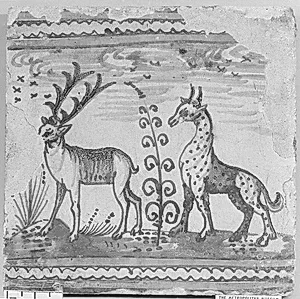
This charming frieze tile, crafted in the Netherlands around 1600, exemplifies the artistry of Dutch tin-glazed earthenware, often called Delftware. Measuring a modest 5⅜ × 5⅜ inches, it was designed to be part of a decorative border or frieze adorning interiors like fireplaces or wainscoting. The tin glaze—a technique involving a lead-tin oxide coating fired over earthenware—created a smooth, white surface ideal for vibrant painted motifs, mimicking costly Chinese porcelain while making luxury accessible to the emerging Dutch middle class. The tile's motifs of giraffes and deer highlight the era's fascination with exotic animals, likely inspired by global trade routes during the Dutch Golden Age. Giraffes, rare in Europe, evoked wonder and the wonders of distant lands reached via the Dutch East India Company. These lively depictions, painted in blue underglaze (a hallmark of early Delftware), served not just as decoration but as conversation pieces, blending whimsy with cultural storytelling. Today, housed in the Metropolitan Museum of Art's European Sculpture and Decorative Arts collection (acquired via the Fletcher Fund in 1927), this anonymous masterpiece offers a glimpse into 17th-century domestic life, where everyday ceramics became canvases for imagination.