
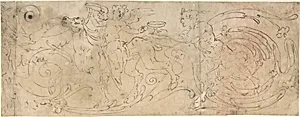
Frieze with Acanthus Rinceau with Grotesques
Medium
Pen and black ink with traces of metalpoint and red chalk
Dimensions
5 13/16 x 15 1/8 in. (14.8 x 38.4 cm)
Classification
Drawings
Department
Drawings and Prints
Museum
Metropolitan Museum of Art, New York, NY
Credit
Purchase, Anne and Carl Stern Gift, 1959
Accession Number
59.642.91
Rights
Public Domain
Tags
Art Historical Context
This delicate drawing, *Frieze with Acanthusinceau with Grotesques*, created by an anonymous Italian artist in the second half of 16th century, the ornate decorative style popular during the late Italian Renaissance. Executed in pen and black ink with subtle traces of metalpoint for underdrawing and red chalk soft modeling, the work measures a modest 5 13/16 x 15 1/8 inches. It depicts a flowing frieze of acanthus leaves—classic scrolling vines inspired by ancient Roman motifs—interwoven with whimsical grotesques, including playful putti (chubby infant figures), mischievous satyrs, and dynamic horses, evoking a fantastical, lively border design likely intended for architecture, furniture, or manuscripts. In the 16th century, such drawings reflected a revival of classical antiquity, drawing from excavations like Nero's Domus Aurea, where "grottesche" (cave-like) decorations were rediscovered. This anonymous sheet exemplifies Mannerist tendencies: intricate, asymmetrical compositions blending natural and mythical elements for visual delight. As a preparatory study in The Metropolitan Museum of Art's Drawings and Prints department (acquired via the Anne and Carl Stern Gift in 1959), it offers insight into the iterative creative process of Renaissance workshops, where artists refined ideas before execution in fresco, stucco, or maiolica. Visitors will appreciate how this frieze captures the era's joy in ornamentation, bridging ancient grandeur with Renaissance ingenuity.