
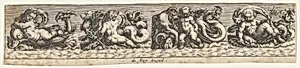
Frieze with Sea Monsters
Medium
Engraving
Dimensions
Sheet: 1 5/8 × 7 13/16 in. (4.2 × 19.9 cm)
Classification
Prints|Ornament & Architecture
Department
Drawings and Prints
Museum
Metropolitan Museum of Art, New York, NY
Credit
Gift of Harry G. Friedman, 1957
Accession Number
57.658.13(2)
Rights
Public Domain
Tags
Art Historical Context
Created around 1580–1600, *Frieze with Sea Monsters* is a delicate engraving that captures the playful yet fantastical spirit of late Renaissance ornament. Attributed to Johann Theodor de Bry and Giovanni Andrea Maglioli, the print depicts a lively procession of mythical sea creatures intertwined with putti, or cherubic figures, in a continuous horizontal design. Measuring just over seven inches wide, its compact format suggests it was intended as a decorative model for artists, architects, or craftsmen to adapt in metalwork, furniture, or architectural details. Engravings like this played a vital role in spreading ornamental patterns across Europe during the period. The precise linework of the medium allowed for intricate details—curling tails, swirling waves, and expressive faces—that would have been copied and reinterpreted in various media. Such friezes drew on classical mythology and maritime lore, reflecting a broader cultural fascination with the sea as both a source of wonder and danger. Today housed in the Metropolitan Museum of Art’s Department of Drawings and Prints, this work exemplifies how prints served as bridges between fine art and applied design, preserving imaginative motifs for generations of makers and viewers.
About the Artist
Johann Theodor de Bry|Giovanni Andrea Maglioli · 1561–1923
Comment on works: copper engraver