
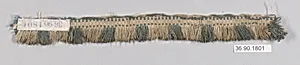
Fringe
Unknown Artist
late 19th century
Dimensions
L. 8 x W. 5/8 inches 20.3 x 1.6 cm
Classification
Textiles-Trimmings
Culture
Italian
Department
European Sculpture and Decorative Arts
Museum
Metropolitan Museum of Art, New York, NY
Credit
Gift of The United Piece Dye Works, 1936
Accession Number
36.90.1801
Rights
Public Domain
Art Historical Context
Nestled in the Metropolitan Museum of Art's Sculpture and Decorative Arts, this delicate *Fringe* exemplifies the exquisite textile trimmings produced in late 19th-century Italy. Crafted by an artist, the piece measures a modest 8 inches long 5/8 inch wide (20.3 x 1.6 cm), highlighting the precision required for such fine decorative elements. Acquired as a gift from The United Piece Dye Works in1936, it reflects the era's vibrant textile industry, where Italy was renowned for luxurious fabrics and embellishments. Fringe like this was a hallmark of opulent design, often adorning garments, upholstery, curtains, and ecclesiastical vestments. In the late 1800s, as Italy unified and industrialized, artisans blended traditional handcrafting techniques—such as weaving, knotting, or braiding threads—with emerging mechanized dyeing processes, creating intricate patterns that added texture and movement to everyday luxury. Though its exact medium remains unspecified, its classification as a trimming underscores its role in elevating the aesthetic of high-society interiors and fashion. Today, this unassuming artifact invites us to appreciate the unsung artistry of decorative textiles, preserving a slice of Italy's cultural heritage. Its small scale belies its significance, reminding visitors how tiny details wove together the grandeur of 19th-century European life. (198 words)