
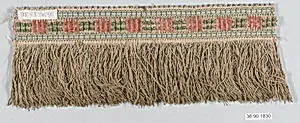
Fringe
Unknown Artist
late 18th century
Medium
Silk
Dimensions
L. 9 3/4 x W. 3 1/2 inches 24.8 x 8.9 cm
Classification
Textiles-Trimmings
Culture
French
Department
European Sculpture and Decorative Arts
Museum
Metropolitan Museum of Art, New York, NY
Credit
Gift of The United Piece Dye Works, 1936
Accession Number
36.90.1830
Rights
Public Domain
Art Historical Context
Step into the opulent world of late 18th-century French fashion with *Fringe*, a delicate silk trimming that exemplifies the era's love for lavish embellishment. Crafted in France during the waning years of the Ancien Régime—just before the French Revolution—this 9¾ x 3½-inch (24.8 x 8.9 cm) piece of silk fringe would have adorned gowns, upholstery, or curtains, adding a playful cascade of texture and movement. Its classification as a textile trimming highlights the meticulous craftsmanship of French workshops, particularly in Lyon, Europe's silk capital, where weavers transformed lustrous threads into symbols of luxury. Silk's shimmering quality made it a prized medium, often hand-knotted or woven into intricate patterns that caught the light during candlelit soirées. This fringe reflects the transition from Rococo extravagance to Neoclassical restraint, where such details provided subtle elegance amid social upheaval. Donated to The Metropolitan Museum of Art in 1936 by The United Piece Dye Works, it preserves a snippet of aristocratic splendor for modern eyes. Today, in the European Sculpture and Decorative Arts department, *Fringe* invites us to appreciate the unsung artistry of textiles—those tactile accents that defined daily life and high society alike.