
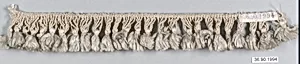
Fringe
Unknown Artist
ca. 1700
Dimensions
L. 10 3/4 x W. 1 1/2 inches 27.3 x 3.8 cm
Classification
Textiles-Trimmings
Culture
French or Swiss
Department
European Sculpture and Decorative Arts
Museum
Metropolitan Museum of Art, New York, NY
Credit
Gift of The United Piece Dye Works, 1936
Accession Number
36.90.1994
Rights
Public Domain
Art Historical Context
This exquisite fringe, dating to around 1700 and attributed to an unknown French or Swiss artisan, exemplifies the refined textile trimmings prized in early 18th-century European arts. Measuring just 10¾ by 1½ inches (27.3 x 3.8 cm), this delicate piece was likely used to adorn garments, upholstery, or furnishings, adding a touch of opulent texture and movement. Housed in the Metropolitan Museum of Art's Department of Sculpture and Decorative Arts, it entered the collection as a gift from The United Piece Dye in 1936, highlighting the enduring appreciation for such craftsmanship. In the late Baroque era, fringes like this were symbols of luxury and status, often featuring intricate weaving or knotting techniques that created cascading bobs or threads for visual drama. Whether from France, a hub of fashionable textiles under Louis XIV, or Switzerland, known for precise linen and silk work, this artifact reflects the era's blend of functionality and artistry. Its preservation offers a glimpse into the skilled hands behind everyday elegance, inviting us to imagine it swaying on a noble's robe or a grand bed canopy. A small treasure, it underscores how decorative details elevated the ordinary to the extraordinary.