
Frog Yoke
Unknown Artist
7th–10th century
Medium
Greenstone, pigment (probably hematite)
Dimensions
H. 5 x W. 14 7/8 x D. 15 3/4 in. (12.7 x 37.8 x 40 cm)
Classification
Stone-Sculpture
Culture
Veracruz
Department
Arts of Africa, Oceania, and the Americas
Museum
Metropolitan Museum of Art, New York, NY
Credit
The Michael C. Rockefeller Memorial Collection, Gift of Nelson A. Rockefeller, 1963
Accession Number
1978.412.15
Rights
Public Domain
Art Historical Context
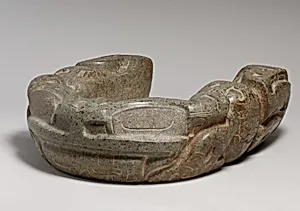
This striking *Frog Yoke* from the ancient Veracruz culture of Mesoamerica, dating to the 7th–10th century, exemplifies the masterful stone carving of pre-Columbian artisans. Carved from durable greenstone—a prized hardstone often likened to jade—and enhanced with red pigment likely derived from hematite, the sculpture measures a compact 5 inches high by nearly 16 inches wide and deep. Its low, belt-like profile and frog motif suggest it was worn around the waist, evoking the amphibian's symbolic ties to water, fertility, and renewal in Mesoamerican cosmology. Veracruz masterpieces like this yoke were integral to the ritual Mesoamerican ballgame, a sacred sport blending athleticism, religion, and social hierarchy. Players donned these protective yet ceremonial pieces during matches, which could symbolize cosmic battles between life and death. The unknown artist's skill shines in the yoke's smooth contours and incised details, achieved through laborious pecking, grinding, and polishing techniques on unyielding stone. Housed in The Metropolitan Museum of Art's Michael C. Rockefeller Memorial Collection, this artifact offers a window into Veracruz's vibrant Classic-period legacy, where art fused daily life with the divine. Visitors, imagine the rhythmic thud of rubber balls against stone courts, echoed by such enduring symbols of power and play.