
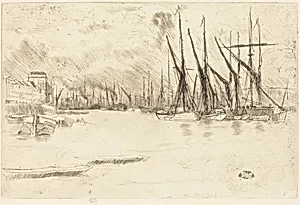
From Pickle-Herring Stairs
c. 1878
Medium
etching and drypoint on laid paper
Classification
Department
CG-W
Museum
National Gallery of Art, Washington, D.C.
Credit
Rosenwald Collection
Accession Number
1943.3.8502
Rights
Public Domain
Art Historical Context
James McNeill Whistler’s *From Pickle-Herring Stairs* (c. 1878) captures a moody glimpse of Victorian London’s Thames River waterfront. This etching and drypoint on laid paper belongs to Whistler’s renowned Thames Set, a series of prints depicting the gritty, industrial riverside neighborhoods like Wapping and Rotherhithe. Pickle-Herring Stairs, a historic set of steps in Southwark once used by fishermen and porters, serves as the vantage point, evoking the bustling yet atmospheric life of 19th-century working-class London. Whistler, an American expatriate in Britain and champion of Aestheticism, prioritized tonal harmony and subtle suggestion over literal detail—a radical departure from Victorian realism. His prints influenced the Impressionists and modern printmaking, emphasizing mood through soft edges and atmospheric effects. Etching creates precise lines via acid on a metal plate, while drypoint adds a velvety burr from direct needle scratches, lending richness to the paper’s texture. Housed in the National Gallery of Art’s Rosenwald Collection, this work exemplifies Whistler’s mastery in transforming everyday scenes into poetic visions. It invites viewers to ponder the fleeting beauty amid urban decay, a hallmark of his enduring legacy. (198 words)
About the Artist
James McNeill Whistler · 1834–1903
James Abbott McNeill Whistler (1834-1903) was an American-born painter and printmaker who became a leading figure in the Aesthetic Movement and pioneer of Tonalism and Japonisme. He revolutionized art by championing "art for art's sake" and treating paintings as visual equivalents of musical compositions, titling works as "arrangements," "harmonies," and "nocturnes" to emphasize formal qualities o...