
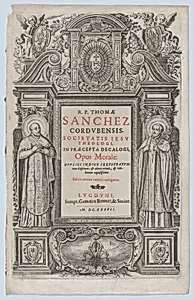
Frontispiece for 'Opus morale in praecepta Decalogi'
1637
Medium
Etching
Dimensions
Plate: 4 1/2 × 5 1/2 in. (11.5 × 14 cm) Sheet: 13 11/16 × 8 1/4 in. (34.7 × 20.9 cm)
Classification
Prints
Department
Drawings and Prints
Museum
Metropolitan Museum of Art, New York, NY
Credit
The Elisha Whittelsey Fund, 1949
Accession Number
49.46.34
Rights
Public Domain
Tags
Art Historical Context
This elegant etching by Charles Audran served as the frontispiece for the1637 publication *Opus morale in praecepta Decalogi*, a moral treatise exploring the Ten Commandments. Created during the height of the Baroque era, the print uses delicate linework and dramatic contrasts typical of etching to introduce readers to themes of divine law and spiritual guidance. The composition features saints and angels alongside male figures, establishing a tone of reverence and moral instruction for the text that follows. Audran, a member of a prominent French family of printmakers, worked at a time when etchings were essential for disseminating religious and philosophical ideas across Europe. Frontispieces like this one were not merely decorative; they acted as visual summaries, inviting contemplation before the reader engaged with the written word. The compact plate size—roughly 4½ by 5½ inches—allowed it to fit neatly within the book while still conveying grandeur through its celestial imagery. Acquired by the Metropolitan Museum of Art through the Elisha Whittelsey Fund in 1949, this print highlights the enduring role of graphic arts in 17th-century religious education. Its presence in the museum’s Drawings and Prints collection offers visitors a glimpse into how artists and authors collaborated to shape moral thought during a period of significant spiritual and cultural change.