
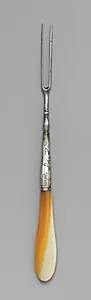
Fruit fork
Unknown Artist
18th century
Medium
Steel, mother-of-pearl (?)
Dimensions
Length: 5 7/8 in. (14.9 cm)
Classification
Metalwork-Steel
Culture
French
Department
European Sculpture and Decorative Arts
Museum
Metropolitan Museum of Art, New York, NY
Credit
Gift of R. Stuyvesant, 1893
Accession Number
93.13.61
Rights
Public Domain
Art Historical Context
This exquisite fruit fork, crafted in 18th-century France by an unknown artisan, exemplifies the refined metalwork the European decorative arts tradition. Measuring just 5 7/8 inches (14.9 cm) in length, it is fashioned from steel, with a handle possibly inlaid or accented with mother-of-l—a luxurious material prized for its iridescent sheen. Such precise construction highlights the era's mastery of metalworking techniques, where functionality met opulence in everyday luxury items. In the opulent world of ancien régime France, fruit forks like this one were essential table accessories for the elite, used to serve fresh fruits with decorum during lavish banquets. They reflect the cultural emphasis on etiquette and display, where even utensils became statements of wealth and sophistication. Steel's durability paired with decorative elements underscores the period's blend of practicality and artistry in household silver alternatives. Now housed in the Metropolitan Museum of Art's Department of European Sculpture and Decorative Arts, this piece entered the collection as a gift from R. Stuyvesant in 1893. It invites us to appreciate the subtle craftsmanship that elevated dining into an art form, offering a tangible glimpse into 18th-century French refinement.