
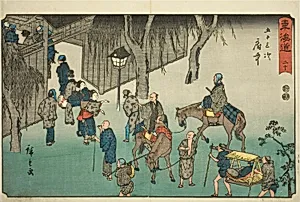
Fuchu—No. 20, from the series "Fifty-three Stations of the Tokaido (Tokaido gojusan tsugi)," also known as the Reisho Tokaido
c. 1847/52
Medium
Color woodblock print; oban
Dimensions
24.1 × 37 cm (9 1/2 × 14 9/16 in.)
Classification
woodblock print
Department
Arts of Asia
Museum
Art Institute of Chicago
Accession Number
25815
Rights
Public Domain
Art Historical Context
Utagawa Hiroshige a master of the ukiyo-e woodblock print tradition, captures the essence of travel along Japan's historic Tōkaidō road in *Fuchu—No. 20* from his renowned series *Fifty-three Stations the Tōkaidō (Tōkaidō gojūsan tsugi)*, also called the Reisho Tōkaidō. Created around 1847–52, this oban-sized color woodblock print (.1 × 37 cm) depicts the bustling station town of Fuchū, the twentieth stop on the vital coastal route linking Edo (modern Tokyo) to Kyoto. Hiroshige's keen eye for atmospheric landscapes and everyday life made this series one of the most beloved in Japanese art history. The Tōkaidō, mandated by the shogunate in the 17th century, facilitated official travel and commerce, inspiring countless prints that romanticized the journey for urban dwellers restricted by sumptuary laws. Hiroshige's innovative techniques—layered colors from multiple woodblocks, subtle gradations (bokashi), and dramatic perspectives—elevate mundane scenes into poetic vignettes, blending realism with evanescent beauty. This print likely showcases travelers amid misty mountains or lively streets, evoking the era's wanderlust. Housed in the Art Institute of Chicago's Arts of Asia collection, it exemplifies ukiyo-e's cultural impact, influencing Western artists like Van Gogh and Whistler during Japonisme. A testament to Edo-period printmaking prowess, it invites visitors to ponder the timeless allure of the road less traveled.
About the Artist
Utagawa Hiroshige · 1826–1869
Utagawa Hiroshige (1797–1858), born Andō Tokutarō, was the last great master of Japanese ukiyo-e woodblock printmaking and one of the most influential landscape artists in history. Born in Edo (modern Tokyo) into a low-ranking samurai family serving as fire wardens, Hiroshige transformed landscape printmaking into a poetic meditation on nature, weather, and everyday life. His revolutionary approac...