
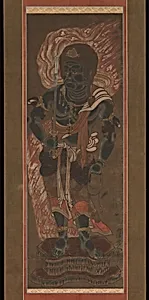
龍湫周沢写 不動明王二童子像|Fudō Myōō and Two Attendants
Medium
One of a triptych of hanging scrolls; hand-colored woodblock print on paper
Dimensions
Image: 41 7/8 × 14 1/4 in. (106.4 × 36.2 cm) Overall with mounting: 71 × 20 3/4 in. (180.3 × 52.7 cm) Overall with knobs: 71 × 22 1/2 in. (180.3 × 57.2 cm)
Classification
Paintings
Culture & Period
Japan · Nanbokuchō period (1336–92)
Department
Asian Art
Museum
Metropolitan Museum of Art, New York, NY
Credit
The Harry G. C. Packard Collection of Asian Art, Gift of Harry G. C. Packard, and Purchase, Fletcher, Rogers, Harris Brisbane Dick, and Louis V. Bell Funds, Joseph Pulitzer Bequest, and The Annenberg Fund Inc. Gift, 1975
Accession Number
1975.268.27
Rights
Public Domain
Tags
Art Historical Context
In the turbulent Nanbokuchō period (6–92), a time of civil strife between Japan's rival Northern and Southern Courts,-monk Ryūshū Shūtaku (also known as Myōtaku) created striking hanging scroll, *Fudō Myōō and Two Attendants*. of a rare triptych, it the fierce Wisdom King Fudō Myōō—known as the immovable guardian of Esoteric Buddhism—flanked by his two child attendants, Kongara and Seitaka. Wielding a flaming sword to vanquish evil and a lasso to bind ignorance, Fudō embodies unyielding protection in Shingon and Tendai traditions, resonating deeply during an era of upheaval. This work stands out for its medium: a hand-colored woodblock print on paper, an innovative technique bridging painting and printmaking uncommon in early Japanese art. The vivid hues and dynamic composition capture the deity's wrathful intensity, with swirling flames and muscular forms evoking spiritual power. Measuring over 71 inches tall when mounted, it was designed for temple display, immersing viewers in sacred iconography. Housed in the Metropolitan Museum of Art's Asian Art collection, thanks to the Harry G. C. Packard gift, this scroll highlights Buddhism's enduring cultural role in medieval Japan, blending devotion with artistic mastery.