
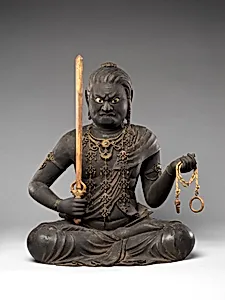
快慶作 不動明王坐像 (Fudō Myōō zazō)|Fudō Myōō, the Immovable Wisdom King (Achala Vidyaraja)
early 13th century
Medium
Japanese cypress with lacquer, color, gold, cut gold leaf (kirikane), and inlaid crystal eyes
Dimensions
H. 21 in. (53.3 cm); W. 16 3/4 in. (42.5 cm); D. 15 in. (38.1 cm)
Classification
Sculpture
Culture & Period
Japan · Kamakura period (1185–1333)
Department
Asian Art
Museum
Metropolitan Museum of Art, New York, NY
Credit
Mary Griggs Burke Collection, Gift of the Mary and Jackson Burke Foundation, 2015
Accession Number
2015.300.252a, b
Rights
Public Domain
Tags
Art Historical Context
This striking wooden sculpture of *Fudō Myōō, the Immovable Wisdom King (Achala Vidyaraja)*, crafted by the master sculptor Kaikei in early 13th century exemplifies the Kamakura period's (1185–1333) revolutionary shift toward realism in Japanese Buddhist art. Seated in a dynamic pose on a rocky throne, the fierce deity wields a sword to vanquish evil and clutches a lasso to bind ignorance, embodying unyielding protection in Esoteric Buddhism. Kaikei, a leading figure in the Kei school, brought unprecedented vitality to religious icons, moving away from the idealized Heian-era styles toward muscular, expressive forms that pulse with spiritual intensity. Carved from Japanese cypress—a durable, fragrant wood favored for its fine grain—the statue is masterfully finished with layered lacquer, vibrant colors, and gold leaf. A highlight is the intricate *kirikane* technique, where tiny gold squares are meticulously cut and applied to create shimmering patterns on flames and robes, evoking divine radiance. The inlaid crystal eyes add a piercing, lifelike gaze, drawing viewers into the figure's wrathful compassion. In Kamakura-era Japan, amid samurai culture and Zen influences, Fudō Myōō symbolized steadfast faith against chaos. This masterpiece from the Metropolitan Museum of Art's Mary Griggs Burke Collection invites contemplation of how art channeled fearsome power into enlightenment, a testament to sculpture's role in daily devotion.