
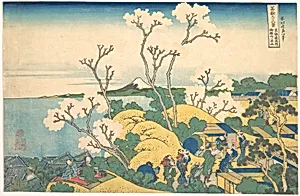
冨嶽三十六景 東海道品川御殿山の不二|Fuji from Gotenyama at Shinagawa on the Tōkaidō (Tōkaidō Shinagawa Gotenyama no Fuji), from the series Thirty-six Views of Mount Fuji (Fugaku sanjūrokkei)
ca. 1830–32
Medium
Woodblock print; ink and color on paper
Dimensions
9 7/8 x 14 7/8 in. (25.1 x 37.8 cm)
Classification
Prints
Culture & Period
Japan · Edo period (1615–1868)
Department
Asian Art
Museum
Metropolitan Museum of Art, New York, NY
Credit
Henry L. Phillips Collection, Bequest of Henry L. Phillips, 1939
Accession Number
JP2992
Rights
Public Domain
Tags
Art Historical Context
In Katsushika Hokusai's iconic series *Thirty-six Views of Mount* (*Fugaku sanjūrokkei*), created around 1830–32 during Japan's Edo period, this wood print captures *Fuji from Goteny at Shinagawa on theōkaidō*. Hokusai, a master of ukiyo-e "pictures of the floating world"—revolutionized Japanese printmaking by elevating landscapes to star status, previously dominated by kabuki actors and courtesans. Mount Fuji, Japan's sacred volcano, appears in myriad moods and settings across the series, symbolizing beauty, power, and transience. Here, the majestic peak looms boldly in the background from Gotenyama hill at Shinagawa, a bustling checkpoint on the Tōkaidō—the vital coastal highway linking Edo (modern Tokyo) to Kyoto. Foreground trees frame the composition, drawing the eye through a dynamic landscape alive with travelers and everyday life. Hokusai's innovative use of Prussian blue pigment creates vivid depth and atmospheric perspective, while the horizontal *ōban* format (9 7/8 x 14 7/8 in.) suited mass production for a growing merchant class audience. This print exemplifies Edo-era cultural fervor for nature and pilgrimage, influencing global art through Japonisme. Part of the Metropolitan Museum of Art's Henry L. Phillips Collection, it invites us to ponder Fuji's enduring allure amid human bustle.
About the Artist
Katsushika Hokusai · 1760–1849
Katsushika Hokusai (1760-1849) stands as one of history's most influential artists, a Japanese master who revolutionized the ukiyo-e woodblock print tradition and profoundly shaped Western art. Born in the Katsushika district of Edo (modern-day Tokyo) to an artisan family, Hokusai lived through nearly nine decades of extraordinary creative evolution, adopting over thirty different artistic names t...