
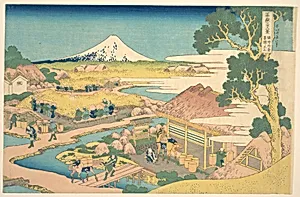
冨嶽三十六景 駿州片倉茶園の不二|Fuji from the Katakura Tea Fields in Suruga (Sunshū Katakura chaen no Fuji), from the series Thirty-six Views of Mount Fuji (Fugaku sanjūrokkei)
ca. 1830–32
Medium
Woodblock print; ink and color on paper
Dimensions
9 5/8 x 14 3/4 in. (24.4 x 37.5 cm)
Classification
Prints
Culture & Period
Japan · Edo period (1615–1868)
Department
Asian Art
Museum
Metropolitan Museum of Art, New York, NY
Credit
Henry L. Phillips Collection, Bequest of Henry L. Phillips, 1939
Accession Number
JP2955
Rights
Public Domain
Tags
Art Historical Context
Katsushika Hokus's *Fuji from the Katakura Fields in Suruga*, around 1830–32, is a captivating woodblock print from his series *Thirty-six Views of Mount Fuji*. During Japan's Edo period (16151868), Hokusai revolutionized ukiyo-e—"pictures of the floating world"—with these innovative landscapes. This print captures Mount Fuji rising majestically behind the verdant Katakura tea fields in Suruga Province, blending everyday rural life with the sacred peak's timeless allure. In the foreground, workers—men and women tending tea bushes amid thatched houses—evoke the rhythm of agricultural labor, while Fuji's snow-capped form dominates the composition. Hokusai's masterful use of ink and vibrant colors on paper, printed via intricate woodblocks, creates depth and atmospheric perspective. The modest dimensions (9⅝ × 14¾ in.) made these affordable prints accessible to all, democratizing art. This work exemplifies Hokusai's genius in portraying Fuji from 36 varied vantage points, influencing global artists like Van Gogh and Whistler. A cultural icon, it celebrates Japan's harmony with nature, inviting viewers to ponder the mountain's enduring spiritual presence.
About the Artist
Katsushika Hokusai · 1760–1849
Katsushika Hokusai (1760-1849) stands as one of history's most influential artists, a Japanese master who revolutionized the ukiyo-e woodblock print tradition and profoundly shaped Western art. Born in the Katsushika district of Edo (modern-day Tokyo) to an artisan family, Hokusai lived through nearly nine decades of extraordinary creative evolution, adopting over thirty different artistic names t...