
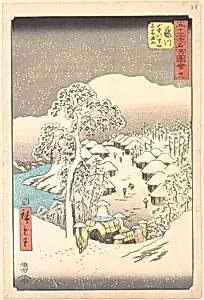
五十三次名所図会 藤川 山中の里別名宮路山|Fujikawa, a Village in the Mountains Formerly Called Miyajiyama
Medium
Woodblock print; ink and color on paper
Dimensions
13 1/2 x 8 7/8 in. (34.3 x 22.5 cm)
Classification
Prints
Culture & Period
Japan · Edo period (1615–1868)
Department
Asian Art
Museum
Metropolitan Museum of Art, New York, NY
Credit
The Howard Mansfield Collection, Purchase, Rogers Fund, 1936
Accession Number
JP2525
Rights
Public Domain
Tags
Art Historical Context
Nestled in the snowy embrace of the mountains, Utagawa Hiroshige's *Fujikawa, a Village in the Mountains (Formerly Called Miyajiyama)* captures a serene winter moment along Japan's historic Tōkaidō road. Created in 1855 as part of his renowned series *The Famous Places of the Fifty-three Stations of the Tōkaidō*, this woodblock print depicts travelers navigating a snow-dusted path through Fujikawa station, blending human figures with dramatic landscapes. Hiroshige, a master of the ukiyo-e ("pictures of the floating world") tradition, elevates everyday journeys into poetic visions. During Japan's Edo period (1615–1868), the Tōkaidō was a vital coastal route linking Edo (modern Tokyo) to Kyoto, bustling with pilgrims, merchants, and samurai under strict travel regulations. Hiroshige's innovative use of perspective, subtle gradations of color, and atmospheric snow effects—achieved through precise woodblock carving and layered inks—brought nature's moods to life, making these affordable prints wildly popular among all classes. This intimate 13½ × 8⅞-inch work exemplifies ukiyo-e's cultural impact, influencing global artists like Van Gogh and Whistler. Now in the Metropolitan Museum of Art's Asian Art collection, it invites us to pause amid the flurry, savoring Hiroshige's timeless harmony of wanderlust and winter wonder.
About the Artist
Utagawa Hiroshige · 1826–1869
Utagawa Hiroshige (1797–1858), born Andō Tokutarō, was the last great master of Japanese ukiyo-e woodblock printmaking and one of the most influential landscape artists in history. Born in Edo (modern Tokyo) into a low-ranking samurai family serving as fire wardens, Hiroshige transformed landscape printmaking into a poetic meditation on nature, weather, and everyday life. His revolutionary approac...