
東海道五十三次 藤澤|Fujisawa
ca. 1840
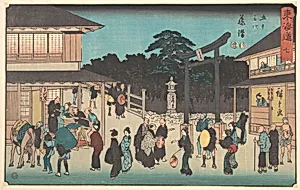
Medium
Woodblock print; ink and color on paper
Dimensions
Overall: 8 3/4 x 13 3/4in. (22.2 x 34.9cm)
Classification
Prints
Culture & Period
Japan · Edo period (1615–1868)
Department
Asian Art
Museum
Metropolitan Museum of Art, New York, NY
Credit
The Francis Lathrop Collection, Purchase, Frederick C. Hewitt Fund, 1911
Accession Number
JP757
Rights
Public Domain
Tags
Art Historical Context
Utagawa Hirosh's *Fujisawa* is a captivating woodblock print from his renowned series *The Fifty-three Stations of the Tōidō* (ca. 1840), which vividly documents the post stations along Japan's historic coastal highway connecting Edo (modern Tokyo) to Kyoto. Created during the Edo period (5–1868), this work captures the everyday vibrancy of travel in feudal Japan, where the Tōkaidō road bustled with pilgrims, merchants, and samurai. Fujisawa, the 19th station, comes alive through Hiroshige's masterful depiction of crowds, houses, trees, and animals, evoking the energy of a roadside inn or checkpoint. Hiroshige, a leading figure in the ukiyo-e ("pictures of the floating world") movement, excelled in landscape prints that emphasized atmospheric beauty over strict realism. Printed with ink and color on paper using the intricate woodblock technique—where artisans carved separate blocks for each hue—this *nishiki-e* (brocade print) showcases subtle gradations and bold contrasts, making art accessible to the masses at low cost. The horizontal *ōban* format (about 8¾ × 13¾ inches) invited viewers to immerse themselves in the scene's dynamic composition. These prints hold immense cultural significance, romanticizing the rigors of travel and preserving a snapshot of Edo-era life before Japan's modernization. Housed in the Metropolitan Museum of Art's Asian Art collection, *Fujisawa* invites us to wander virtually along the ancient road, appreciating Hiroshige's poetic eye for the fleeting beauty of the everyday.
About the Artist
Utagawa Hiroshige · 1826–1869
Utagawa Hiroshige (1797–1858), born Andō Tokutarō, was the last great master of Japanese ukiyo-e woodblock printmaking and one of the most influential landscape artists in history. Born in Edo (modern Tokyo) into a low-ranking samurai family serving as fire wardens, Hiroshige transformed landscape printmaking into a poetic meditation on nature, weather, and everyday life. His revolutionary approac...