
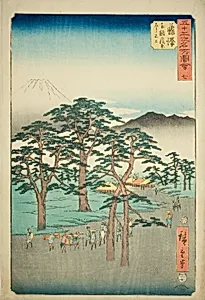
Fujisawa: Mount Fuji on the Left from the Nanki Pine Grove (Fujisawa, Nanki no Matsubara hidari no Fuji), no. 7 from the series "Famous Sights of the Fifty-three Stations (Gojusan tsugi meisho zue)," also known as the Vertical Tokaido
Medium
Color woodblock print; oban
Dimensions
37 × 25.1 cm (14 9/16 × 9 7/8 in.)
Classification
woodblock print
Department
Arts of Asia
Museum
Art Institute of Chicago
Accession Number
25514
Rights
Public Domain
Art Historical Context
Utagawa Hiroshige’s 1855 color woodblock print captures a serene moment along Japan’s historic Tōkaidō highway. Created as the seventh design in his “Famous Sights of the Fifty-three Stations,” also called the Vertical Tōkaidō, the oban-sized print shows travelers pausing amid the tall pines of Fujisawa’s Nanki grove, with the graceful cone of Mount Fuji rising to the left. By this late stage of his career, Hiroshige had already transformed the ukiyo-e landscape tradition, using subtle gradations of color and elegant cropping to turn everyday travel scenes into poetic visions. Printed with the refined techniques of the Edo period—multiple blocks for delicate blues, soft greens, and atmospheric perspective—the work invites viewers to share the quiet awe felt by those on the road between Edo and Kyoto. Mount Fuji, a symbol of enduring beauty and spiritual power, anchors the composition, reminding audiences of the sacred landscape that defined Japanese identity. Today, this impression in the Art Institute of Chicago’s collection continues to charm visitors with its blend of precise observation and lyrical feeling, offering a window into mid-nineteenth-century Japan’s love of travel and nature.
About the Artist
Utagawa Hiroshige · 1826–1869
Utagawa Hiroshige (1797–1858), born Andō Tokutarō, was the last great master of Japanese ukiyo-e woodblock printmaking and one of the most influential landscape artists in history. Born in Edo (modern Tokyo) into a low-ranking samurai family serving as fire wardens, Hiroshige transformed landscape printmaking into a poetic meditation on nature, weather, and everyday life. His revolutionary approac...