
Fumette
Medium
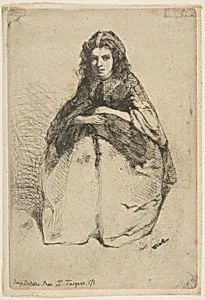
Etching, printed in black ink on fine ivory laid paper; fifth state of five (Glasgow)
Dimensions
Plate: 6 7/16 × 4 5/16 in. (16.4 × 11 cm) Sheet: 6 5/8 x 4 9/16 in. (16.8 x 11.6 cm)
Classification
Prints
Department
Drawings and Prints
Museum
Metropolitan Museum of Art, New York, NY
Credit
Gift of William Loring Andrews, 1883, transferred from the Library
Accession Number
83.1.26
Rights
Public Domain
Tags
Art Historical Context
James McNeill Whistler’s *Fumette* (1858) captures a poised young woman—likely a Parisian model nicknamed "Little Smoker"—in a moment of quiet intensity. Created during Whistler formative years in Paris, this reflects his immersion in the French art scene, where he befriended Realist painters like Henri Fantin-Latour and Alphonse Legros. title, French slang for a female smoker, evokes the bohemian undercurrents of mid-19th-century Paris, blending everyday realism with Whistler’s emerging aesthetic sensitivity. Printed in black ink on fine ivory laid paper, this fifth state of five (as cataloged in the Glasgow edition) showcases Whistler’s virtuoso etching technique. Using a needle to incise lines into a copper plate, he achieved delicate, fluid strokes that suggest texture and form with remarkable subtlety—no aquatint or other aids needed. This print exemplifies the 19th-century etching revival, prioritizing tonal nuance over rigid detail, a hallmark of Whistler’s style that later influenced his famous paintings like *Arrangement in Grey and Black No.1*. Housed in the Metropolitan Museum of Art’s Drawings and Prints department (gift of William Loring Andrews, 1883), *Fumette* highlights Whistler’s early mastery and his lifelong pursuit of harmony and suggestion over literalism, inviting viewers to savor its elegant restraint.
About the Artist
James McNeill Whistler · 1834–1903
James Abbott McNeill Whistler (1834-1903) was an American-born painter and printmaker who became a leading figure in the Aesthetic Movement and pioneer of Tonalism and Japonisme. He revolutionized art by championing "art for art's sake" and treating paintings as visual equivalents of musical compositions, titling works as "arrangements," "harmonies," and "nocturnes" to emphasize formal qualities o...