
Funerary Mask
Unknown Artist
A.D. 2nd century
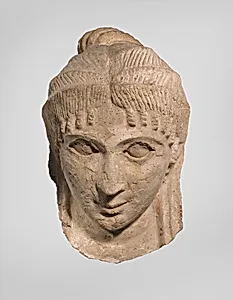
Medium
Plaster, paint
Dimensions
h. 19 cm (7 1/2 in); w. 10.5 cm (4 1/8 in)
Classification
Mask, woman
Period
Roman Period
Department
Egyptian Art
Museum
Metropolitan Museum of Art, New York, NY
Credit
Funds from various donors, 1900
Accession Number
00.2.26
Rights
Public Domain
Tags
Art Historical Context
This delicate funerary mask, crafted in the 2nd century.D. during Egypt's Roman Period, exemplifies the fusion of Egyptian afterlife beliefs with Greco-Roman portraiture traditions. Measuring just 19 cm high and .5 cm wide, it was likely placed over a mummy's face to protect the deceased's spirit and aid its journey to the afterlife. Produced by an unknown artist using plaster molded into a lifelike form and vividly painted, such masks were common in Roman Egypt, reflecting the cultural blending after Cleopatra's defeat in 30 B.C. The medium of plaster—lightweight, moldable, and ideal for intricate details—allowed for realistic facial features, often modeled after the individual. Pigments in black, red, and gold evoked vitality and divinity, with stylized hair and jewelry nodding to both local pharaonic iconography and Roman realism, akin to the famous Fayum mummy portraits. These artifacts highlight how Egyptians adapted mummification under imperial rule, personalizing eternity for everyday people, not just pharaohs. Housed in the Metropolitan Museum of Art's Egyptian Art department, this mask offers a poignant glimpse into ancient hopes for immortality, reminding us of the enduring human desire to defy death through art.