
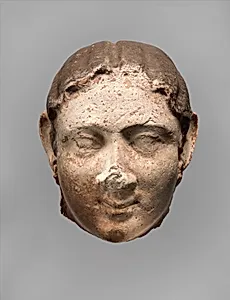
Funerary Mask
Unknown Artist
A.D. 1st–4th century
Medium
Plaster, paint
Dimensions
h. 19 cm (7 1/2 in); w. 11 cm (4 5/16 in)
Classification
Mask, woman
Period
Roman Period
Department
Egyptian Art
Museum
Metropolitan Museum of Art, New York, NY
Credit
Funds from various donors, 1900
Accession Number
00.2.7
Rights
Public Domain
Tags
Art Historical Context
This funerary mask, created during Egypt’s Roman Period in the1st–4th century A.D., reflects the blending of ancient Egyptian burial traditions with Roman influences. Crafted from plaster and painted to capture the likeness of the deceased, such masks were placed over the face of a mummy to help preserve the individual’s identity for the afterlife. The modest size—roughly 19 centimeters high—suggests it may have been made for a child or young person, offering a poignant glimpse into personal loss in the ancient world. The use of plaster allowed artisans to mold realistic facial features while paint added lifelike details such as skin tone, hair, and jewelry. In Roman Egypt, these masks replaced the earlier cartonnage or gold masks, adapting to new materials and tastes while maintaining the core Egyptian belief that the soul needed a recognizable body to return to. Acquired by the Metropolitan Museum in 1900, the piece stands as a quiet testament to the continuity of funerary customs across cultural shifts. Today, visitors can appreciate how this intimate object bridges two civilizations, reminding us that even in a time of empire and change, the desire to remember loved ones endured.