
Furniture element
Unknown Artist
ca. 9th century BCE
Medium
Glass, Egyptian Blue
Dimensions
1.46 x 2.09 x 3.15 in. (3.71 x 5.31 x 8 cm)
Classification
Glass-Ornaments
Culture & Period
Iran · Iron Age II, Hasanlu Period IV
Department
Ancient Near Eastern Art
Museum
Metropolitan Museum of Art, New York, NY
Credit
Purchase, The Adelaide Milton de Groot Fund, in memory of the de Groot and Hawley families, 1976
Accession Number
1976.233.1
Rights
Public Domain
Art Historical Context
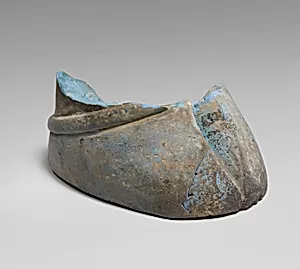
This delicate furniture element, crafted around the 9th century BCE during Iron Age II in ancient Iran (Hasanlu Period IV), offers a glimpse into the sophisticated artistry of the Ancient Near East. Unearthed from the Hasanlu site—a bustling settlement in northwestern Iran destroyed by fire circa 800 BCE—this tiny ornament (just 1.46 x 2.09 x 3.15 inches) likely served as an inlay for high-status furniture, adorning tables or chairs belonging to local elites. Its presence highlights the region's role as a cultural crossroads, blending influences from Mesopotamia, the Levant, and beyond. Made of vibrant Egyptian Blue glass—a synthetic cobalt-based frit invented by Egyptians millennia earlier and prized across the Near East for its enduring turquoise hue—this piece showcases advanced pyrotechnic skills. Artisans melted silica, copper, and lime at high temperatures to create this durable, gem-like material, often used for jewelry and luxury goods. Such glasswork symbolized wealth and technological prowess, bridging trade networks that spanned empires. Acquired by The Metropolitan Museum of Art in 1976 through the Adelaide Milton de Groot Fund, this ornament invites us to imagine the opulent interiors of Iron Age Iran, where everyday objects pulsed with color and prestige. A testament to forgotten craftsmanship, it reminds us how small artifacts illuminate vast ancient worlds.